Rev. (Mrs.) Angela Carmen Appiah Makes History as First Female President of IoD-Gh

In a groundbreaking development, Rev. (Mrs.) Angela Carmen Appiah, an Assistant Registrar for the Nursing and Midwifery Council, has been elected as the president of the Institute of Directors-Ghana (IoD-Gh). This historic achievement marks the first time a woman has assumed the presidency since the establishment of the professional body 24 years ago. The election took place during the Institute’s 17th Annual General Meeting and Council Elections, held virtually via Zoom Video Conferencing on May 11, 2023. Mrs. Appiah, currently serving as the Vice-President and a Fellow of IoD-Gh, emerged as the successful candidate for the presidency. Throughout her career, Mrs. Appiah has demonstrated her leadership abilities and commitment to excellence. She has previously chaired three Interim Management Committees (IMC) and played a pivotal role in managing transitions. Additionally, Mrs. Appiah has served as the Chair of the Regional Outreach Committee (RoC), contributing significantly to the establishment of regional branches. In addition to her role at IoD-Gh, Mrs. Carmen Appiah is a Fellow at the Ghana College of Nurses and Midwives (GCNM) and provides valuable technical support to the Ghana Tertiary Education Commission (GTEC). Following the announcement of her election, Mrs. Carmen Appiah expressed her gratitude for the opportunity to lead the Institute and shared her vision for the future. She emphasized the importance of considering all stakeholders, both locally and internationally, and fostering collaboration among members to elevate IoD-Gh to new heights. Assisting Mrs. Carmen Appiah in her responsibilities is Vice-President Mary Asare-Yeboah, a licensed Insolvency Practitioner known for her expertise in the field. The newly elected IoD-Gh Council, comprising the President, Vice President, and eight additional members, will serve for the next two years. This diverse group of accomplished professionals includes experts from various sectors, ensuring a well-rounded and inclusive leadership team: With Rev. (Mrs.) Angela Carmen Appiah at the helm and the collective expertise of the newly elected council, IoD-Gh is poised to embark on an exciting journey, advancing its mission and raising the organization’s profile both nationally and internationally. READ NEXT ON: Daniel Boifio Jr, Young Ghanaian, Secures His First FIFA Football Agent Certification
Osu Castle: Unveiling the History and Legacy of Ghana’s Iconic Fortress

The origins of the Osu Castle date back to the 1660s when it was initially constructed by Denmark-Norway. Over time, the fort changed hands between Denmark-Norway, Portugal, the Akwamu people, Britain, and eventually post-independence Ghana. During Denmark-Norway’s control, it served as the capital of the Danish Gold Coast and played a significant role in the transatlantic slave trade by holding and dispatching enslaved individuals. Osu Castle, also known as Fort Christiansborg or the Castle, is a historic fortress situated in Osu, Ghana, along the coast of the Gulf of Guinea in Africa. In 1902, Osu Castle became the seat of government in Ghana, although this has since been relocated to the Golden Jubilee House. The castle holds great historical significance as it testifies to European colonial influence in West Africa and the devastating impact of the Atlantic slave trade. In recognition of its historical value, the castle was inscribed on the UNESCO World Heritage List in 1979, along with several other castles and forts in Ghana. The area where Osu Castle is situated was initially occupied by the Portuguese in 1550. However, Portuguese influence diminished in the 17th century. The region came under Swedish control in the 1650s through the efforts of German trader Heinrich Carloff. In 1652, Carloff obtained permission from the King of Accra to build a small fortified lodge. Control of the area shifted to the Netherlands in 1660 but was soon lost to Denmark-Norway. During this time, Carloff, now representing Denmark-Norway, returned to Africa and successfully conquered the forts he had previously established, including Osu. Initially used for trading gold and ivory, the castle’s focus shifted to the slave trade under Danish control. Adjacent to Osu Castle were two other forts—Fort Crèvecœur controlled by the Dutch and Fort James controlled by the British. As the settlement at Osu was too small to compete with the neighboring forts, Denmark-Norway purchased additional land and expanded the building, renaming it Fort Christiansborg after King Christian V of Denmark. It should be noted that this fort should not be confused with the royal palace in Copenhagen, which shares a similar name. Denmark-Norway occupied the fort for most of the next two centuries, with some interruptions. For a significant portion of that time, it served as the capital of the Danish Gold Coast. In 1679 or 1680, a mutiny orchestrated by the Greek assistant commander led to the murder of the fort’s commander. Shortly thereafter, a Portuguese ship under the command of Julião de Campos Barreto visited the fort and agreed to purchase it. The fort was then renamed Fort São Francisco Xavier after the Catholic missionary Francis Xavier. However, the Portuguese abandoned the fort on August 29, 1682, following a mutiny within their garrison and the realization that they could not compete with other powers on the Gold Coast. Denmark-Norway repurchased the fort from the Portuguese in February 1683. In 1685, Fort Christiansborg became the capital of the Danish Gold Coast, replacing Fort Frederiksborg. In 1693, the Akwamu ethnic group infiltrated the fort disguised as merchants and overpowered the occupants, who were weakened by death and disease. Assameni, the Akwamu leader, occupied the fort for a year and engaged in trade with merchants from various nations. In 1694, Assameni sold the fort back to Denmark-Norway for 50 marks of gold, but the Akwamu retained possession of the keys, which are still in their possession to this day. The fort faced challenging times in the early 18th century and was reported to be in disrepair by the English in 1722. However, extensions and structural improvements were made later in the century, with further expansions in 1824. These additions included additional storage rooms, garrison quarters, platforms, bastions, and houses, resulting in the castle being four times its original size. In the 1770s, the Danes at Osu Castle found themselves embroiled in a conflict with Dutch-controlled Accra. In 1850, the British acquired all of Denmark’s possessions on the Gold Coast, including Fort Christiansborg, for £10,000. Denmark had been considering selling these outposts for some time, as they were costly to maintain and no longer provided significant benefits. The British, motivated by their commitment to ending illegal slave trading and preventing the strengthening of French or Belgian influence in the region, took over the fort. However, an earthquake in 1862 destroyed most of the upper floors, which were subsequently rebuilt using wood. During the late 19th century, the castle served as the seat of the colonial government. However, it was temporarily abandoned by the British colonial powers from 1890 to 1901. During this period, it was utilized as a constabulary mess and later converted into a psychiatric asylum. The castle regained its status as the seat of government in 1902. In 1950, the wooden upper floors were reconstructed according to the original Danish plans. When Ghana gained independence in 1957, with Queen Elizabeth II as the head of state, the fort became Government House and served as the residence of the Governor-General. Following Ghana’s transition to a republic in 1960, it became the official residence of Ghana’s first president, Kwame Nkrumah. In 2005, a debate arose regarding whether Osu Castle should continue to serve as the seat of government. President John Kufuor argued against using the castle due to its historical association with slavery and its inadequate facilities. Members of the National Democratic Congress, however, contended that the $50 million required to build a new presidential palace could be better allocated elsewhere. Today, Osu Castle stands as a symbol of Ghana’s complex history, showcasing the enduring remnants of European colonialism and the painful legacy of the transatlantic slave trade. While its role as the seat of government has shifted, the castle remains an important historical site and a reminder of the country’s journey towards independence and self-determination. READ NEXT ON: Suntaa Beach Boxx
Bima Music & Dance

Bima Frafra is a form of recreational music that is deeply rooted in the culture of the Frafra people, who reside in northern Ghana. It is often performed by the youth during social gatherings or in prominent locations like the community’s market square. Additionally, it is sometimes played during funerals of members associated with Bima Frafra groups, although this practice may not be commonly observed. Another name for this music and dance style among the Frafra people is Akampa. The music of Bima Frafra relies on two main types of drums. The first drum is called the donno, which is a unique double-headed, hourglass-shaped drum. It is played by holding it under one arm and striking it with a curved wooden stick. The donno drum features leather or gut strings that are attached to both drumheads. By adjusting the tension of these strings with the arm and fingers, the player can alter the pitch of the drum. The donno produces various pitches and pitch inflections, but the fundamental patterns in Bima Frafra typically consist of high, low, and muted tones. Low tones are achieved by reducing the tension on the strings and drumheads, while high tones require increased tension. Mute strokes involve pressing the stick against the drumhead with high tension, resulting in a muffled resonance. The second drum used in Bima Frafra is called the mpintintoa. This drum is circular and bowl-shaped, made from a lightweight hollow gourd with a single membrane stretched across the upper opening. It produces a low tone and is played using the hands. Similar to the donno, the mpintintoa drum has basic patterns consisting of mute and open tones. Mutes are created by applying hand pressure on the drumhead during the stroke, producing muffled sounds. On the other hand, open tones are produced by withdrawing the hand upon contact, resulting in less resonant and muffled sounds. Bima Frafra music showcases the rich musical heritage of the Frafra people, serving as a vital part of their cultural expression and community gatherings. The combination of the donno and mpintintoa drums creates a rhythmic and melodic foundation for the music, allowing for engaging performances and vibrant celebrations. READ NEXT ON: Background & History of Adzogbo
Background & History of St. Monica’s Senior High School
St. Monica’s Senior High School is an esteemed girls’ second-cycle institution located in Mampong, a town situated in the Ashanti Region of Ghana. The school can be found along the Kumasi-Mampong Highway, approximately 40 kilometers (25 miles) away from Kumasi. Due to its hilly surroundings, the area experiences a consistently cool climate. St. Monica’s is bordered by the Ghana Highways Authority in Mampong to the north, the Mampong Municipal Hospital to the south, the Mampong Babies’ Home to the east, and the Ejura-Mampong Highway to the west. The school’s history can be traced back to Rt Rev John Orfeur Aglionby, the Anglican Bishop of the Gold Coast, who played a pivotal role in establishing the Convent of Our Lady and Saint Monica. In 1926, Bishop Aglionby invited the sisters of the Order of the Holy Paraclete from England to establish a school dedicated to the education of young girls. This marked the beginning of St. Monica’s Secondary School in Mampong. Initially, the school was established as a part of the Teacher Training College. However, in 1946, it gained autonomy and became a separate institution focused solely on secondary education. Over the years, St. Monica’s Senior High School has developed a strong reputation for providing quality education to young women in the region. The school aims to empower its students with knowledge and skills, enabling them to excel academically and contribute meaningfully to society. With a dedicated faculty and staff, St. Monica’s is committed to creating a conducive learning environment that fosters academic excellence, personal growth, and character development. Beyond academics, the school emphasizes the holistic development of its students. Various extracurricular activities, such as sports, cultural performances, and clubs, are offered to encourage students’ talents and interests. St. Monica’s Senior High School also instills moral values, discipline, and a sense of responsibility in its students, shaping them into well-rounded individuals who are prepared to face the challenges of life. As a respected educational institution in the Ashanti Region, St. Monica’s Senior High School continues to play a vital role in empowering young women and contributing to the advancement of education in Ghana. Notable Alumni READ NEXT ON: History of St. Rose’s Senior High School
6 Benefits of Using Influencers in Your Digital Marketing Strategy

In recent years, using influencers in your digital marketing strategy has become increasingly popular. Influencers are individuals with a significant online following who have the ability to influence the purchasing decisions of their followers. By partnering with influencers, businesses can tap into their audiences and promote their products or services to a wider audience. In this article, we will discuss the benefits of using influencers in your digital marketing strategy. Increased Brand Awareness One of the main benefits of using influencers in your digital marketing strategy is increased brand awareness. Influencers have a significant online following, and by partnering with them, businesses can tap into their audiences and increase brand exposure. When an influencer promotes a product or service, their followers are more likely to take notice and consider purchasing it. This can lead to increased brand awareness and reach for the business. Improved Credibility and Trust Influencers have established credibility and trust with their followers, and by partnering with them, businesses can leverage this trust to promote their products or services. When an influencer recommends a product or service, their followers are more likely to trust their opinion and make a purchase. This is particularly true for micro-influencers, who have a smaller but highly engaged following and are often seen as more authentic and relatable than larger influencers. By partnering with micro-influencers, businesses can improve their credibility and build trust with potential customers. Targeted Marketing Influencers often have a specific niche or area of expertise, and businesses can leverage this to reach a targeted audience. For example, if a business sells fitness products, partnering with a fitness influencer can help them reach a targeted audience of fitness enthusiasts. This targeted marketing approach can lead to higher conversion rates and a better return on investment (ROI) for businesses. Cost-Effective Marketing Partnering with influencers can be a cost-effective marketing strategy compared to traditional advertising methods. While larger influencers may command high fees for partnerships, micro-influencers often have lower rates and can be more cost-effective for businesses with smaller budgets. Additionally, influencer marketing often has a higher ROI compared to other forms of digital marketing, making it a valuable investment for businesses. Increased Engagement Influencers have a highly engaged following, and by partnering with them, businesses can increase engagement with their brand. Influencer promotions often involve interactive content, such as product reviews, giveaways, and sponsored posts, which can generate more likes, comments, and shares than traditional advertising methods. This increased engagement can lead to more brand awareness, increased website traffic, and higher conversion rates for businesses. Authentic Content Creation Influencers are experts at creating authentic and engaging content that resonates with their followers. By partnering with influencers, businesses can tap into their creativity and expertise to create authentic and compelling content that promotes their products or services. This can lead to higher engagement and better results compared to traditional advertising methods that may feel forced or inauthentic. In conclusion, using influencers in your digital marketing strategy can have numerous benefits, including increased brand awareness, improved credibility and trust, targeted marketing, cost-effectiveness, increased engagement, and authentic content creation. However, it is important for businesses to carefully select influencers who align with their brand values and target audience, and to ensure that any partnerships are transparent and comply with advertising regulations. By partnering with the right influencers and implementing an effective influencer marketing strategy, businesses can successfully leverage the power of social media and increase their reach, engagement, and conversions. READ NEXT ON: How to Find the Right Influencer for Your Brand
The impact of toxic workplaces on mental health

The workplace is where we spend a significant amount of our time, and it plays an important role in shaping our overall well-being. A toxic workplace can have a detrimental impact on an individual’s mental health, leading to various negative consequences. In this article, we will explore the impact of toxic workplaces on mental health. What is a toxic workplace? A toxic workplace is characterized by an unhealthy work environment that negatively affects the mental, emotional, and physical well-being of employees. Toxic workplaces are characterized by a range of behaviors and practices that include but are not limited to bullying, harassment, discrimination, unrealistic expectations, overworking, and poor management. These practices can lead to chronic stress, anxiety, and depression among employees. Impact of toxic workplaces on mental health Toxic workplaces can lead to a range of negative mental health outcomes, including stress, anxiety, depression, and burnout. Chronic stress is one of the most common outcomes of a toxic workplace. This is because toxic workplaces are characterized by a culture of overworking, unrealistic expectations, and a lack of support from management. When employees are constantly under pressure to meet unrealistic targets, it can lead to chronic stress, which can have a significant impact on mental health. Anxiety and depression are also common outcomes of a toxic workplace. When employees are subjected to bullying, harassment, or discrimination, it can lead to feelings of insecurity, self-doubt, and low self-esteem, which can trigger anxiety and depression. Moreover, employees who experience such behaviors may also feel isolated and unsupported, which can exacerbate their mental health problems. Burnout is another common outcome of a toxic workplace. Burnout is a state of emotional, physical, and mental exhaustion that results from prolonged exposure to stressors in the workplace. Toxic workplaces are known to be high-pressure environments that demand a lot from their employees, often without providing the necessary support or resources. This can lead to burnout, which can have serious consequences for mental health. Other negative outcomes of toxic workplaces include decreased job satisfaction, decreased motivation, and decreased productivity. When employees feel unsupported, undervalued, and overworked, it can lead to a decrease in their motivation and productivity. This, in turn, can lead to decreased job satisfaction, which can have a negative impact on mental health. What can be done? There are several things that can be done to mitigate the impact of toxic workplaces on mental health. Firstly, it is important to create a culture of respect and support in the workplace. This can be done by promoting open communication, providing support and resources to employees, and addressing any behaviors or practices that may be contributing to a toxic workplace environment. Secondly, it is important to provide employees with the necessary resources and support to manage their mental health. This can include providing access to counseling or therapy services, promoting work-life balance, and offering flexible working arrangements. Employees should feel empowered to take care of their mental health and should not be penalized or stigmatized for doing so. Thirdly, it is important to address any bullying, harassment, or discrimination that may be occurring in the workplace. This can be done by implementing zero-tolerance policies, providing training to employees and managers on appropriate behavior, and taking swift action when incidents are reported. Finally, it is important to have effective management practices in place. This includes providing clear expectations and goals, offering regular feedback and recognition, and creating a supportive and positive work environment. Effective management practices can help to prevent burnout, increase job satisfaction, and improve overall mental health. Conclusion A toxic workplace can have a significant impact on an individual’s mental health, leading to a range of negative outcomes such as stress, and anxiety. depression, and burnout. It is important for employers to recognize the impact of toxic workplaces on mental health and take steps to create a supportive and healthy work environment. This includes promoting a culture of respect and support, providing resources and support for mental health, addressing bullying and discrimination, and implementing effective management practices. By taking these steps, employers can create a workplace that promotes mental health, improves job satisfaction, and increases productivity. READ NEXT ON: 10 Ways to Address Toxic Behaviors in the Workplace
The Life and Legacy of Theodosia Salome Okoh

Theodosia Salome Okoh’s impact on Ghanaian art, education, and sports cannot be overstated. She was a pioneering figure who helped shape Ghana’s cultural identity, both domestically and internationally. Her contributions to these fields have left a lasting legacy that continues to inspire generations of Ghanaians. Okoh’s journey began in Effiduase, where she was born to a family of eight children. She had the opportunity to travel extensively with her father, which exposed her to different parts of Ghana and the world. Her education began at the Ashanti Efiduasi Primary School before continuing to the Basel Mission Middle, Senior, and Teacher Training Schools in Agogo. She then attended Achimota School, where she received three years of training in Fine Art. This education laid the foundation for her career as an artist and teacher. Okoh’s artwork earned her international recognition and was exhibited in various countries. However, her most famous work was the design of Ghana’s national flag, which she submitted in 1957 when Ghana gained independence from British colonial rule. Her flag design was eventually chosen as the national flag by the country’s first president, Kwame Nkrumah. Her use of the colors red, gold, and green, which represent the geography and history of Ghana, has become an enduring symbol of Ghana’s identity. Aside from her work in the arts, Okoh was also an instrumental figure in the development of hockey in Ghana. She became the first female chairman of the Ghana Hockey Association and later the President of the Ghana Hockey Federation for over 20 years. During her tenure, Ghana qualified for both the Hockey World Cup and the Olympic Games. Her contributions to the sport earned her the nickname “the Joan of Arc of Ghana hockey” by Ohene Djan. Okoh’s dedication to sports and education extended beyond hockey. She was a long-time patron of the Sports Writers Association of Ghana and received numerous accolades for her contributions to these fields. Her legacy is a testament to the power of individuals who use their talents to make a positive impact on their communities. Theodosia Salome Okoh’s passing on April 19, 2015, marked the end of a remarkable life. However, her influence continues to be felt in Ghana and beyond. In recognition of her contributions, the National Hockey Stadium in Accra was named after her in 2004. Okoh’s life is a shining example of the transformative power of art, education, and sports to shape a nation’s identity and inspire future generations. READ NEXT ON: Remembering Hannah Kudjoe: A Political Icon in Ghana’s History
Background & History of Adzogbo
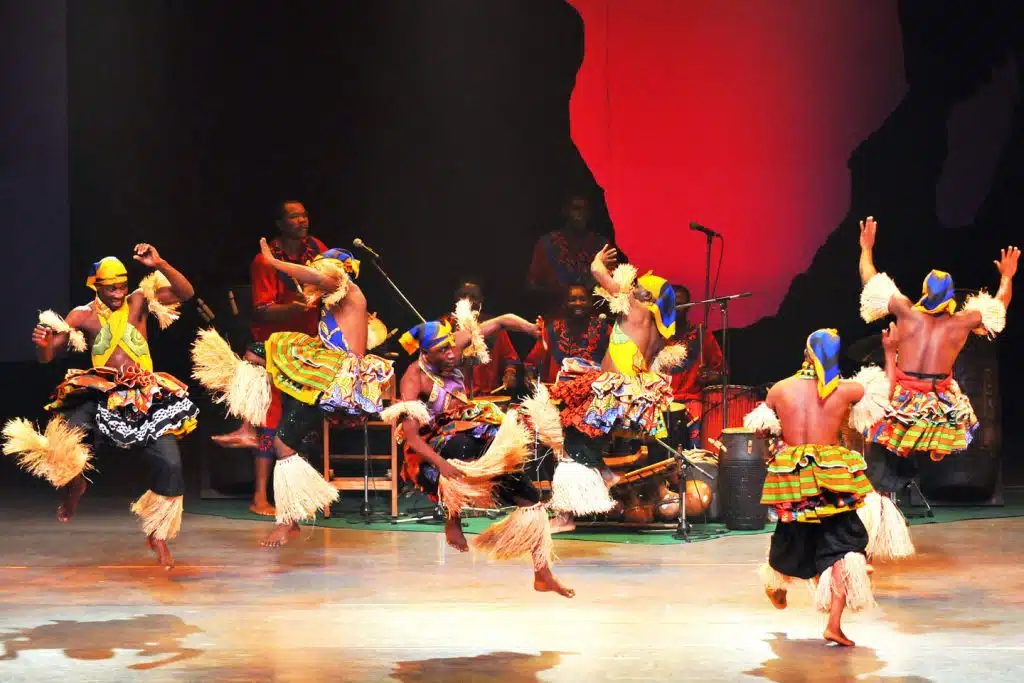
Adzogbo, a traditional music and dance form, has its roots in Benin (formerly Dahomey) as a Dzovu, a spiritual and religious music and dance. Originally, it was known as Dzovu because the male performers would showcase their juju or charms, particularly love charms, during the performance to attract women. However, when the music and dance were introduced to Togo and later Ghana in the late 19th century, their purpose changed. The southeastern Ewe of Ghana now performs Adzogbo for entertainment during festivals and other social occasions. The dance consists of several phases, and the women’s section or phase is known as Kadodo. Today, Adzogbo remains an integral part of the cultural heritage of the Ewe people, with its rhythmic beats, colorful costumes, and energetic movements showcasing the rich cultural diversity of Ghana. Adzogbo is a traditional music and dance that originated from the Benin Kingdom, also known as Dahomey. Originally, it was called Dzovu and was primarily used as spiritual or religious music and dance. During performances, men would display their dzoka or juju charms, especially the so-called “love charms,” to seduce women. The music and dance eventually made its way to Togo and then Ghana in the late 19th century. However, its function and purpose changed as it became more widely performed and adopted by different groups of people. The southeastern Ewe people of Ghana, in particular, have embraced Adzogbo as a form of entertainment during festivals and other social occasions. The Adzogbo dance typically involves a group of performers dressed in colorful costumes, with the dancers moving in unison to the rhythm of the music. The dance is characterized by its energetic and vibrant movements, with the performers often incorporating acrobatics and other physically demanding feats. One unique aspect of Adzogbo is the presence of the women’s section or phase of the dance, which is called Kadodo. During this phase of the dance, women lead the performance, showcasing their own unique movements and styles. Overall, Adzogbo is a testament to the rich cultural heritage of the Ewe people of Ghana and the wider West African region. It continues to be an important part of their social and cultural life, as well as a symbol of their identity and traditions. READ NEXT ON: Asaadua Dance
Daniel Boifio Jr, Young Ghanaian, Secures His First FIFA Football Agent Certification

Daniel Boifio Jr, a 25-year-old graduate of Valley View University, has become one of the few candidates to pass a rigorous exam conducted by the Ghana Football Association. The exam was aimed at assessing candidates’ knowledge and competence to provide agent services in the context of transfers worldwide, and only those who passed would be issued a license to undertake agency duties in football. The exam, which took place at the Ghana Football Association Secretariat in Accra, was considered to be very tough, and there were initial fears that up to 80% of the candidates would fail. However, Boifio Jr, along with 52% of the candidates, was able to obtain the required mark to be issued a license. The names of those who failed the exam have not been made public, but they will have the opportunity to resit on September 20. However, if they fail again, they will not be able to work on transfers, contract negotiations, or speak to clubs without being in the company of a registered agent from October 1. Further resits will also be available in May and November of next year. Boifio Jr’s success in passing the exam is a significant achievement, and it means that he is now fully certified to work on transfers, contract negotiations, or speak to clubs. This certification is expected to open up a plethora of opportunities for him in the football industry, and he will be able to assist players and clubs navigate the transfer process successfully. READ NEXT ON: Amy Tetteh Wins 2023 World Art Day Challenge
History of St. Rose’s Senior High School

St. Rose’s Senior High School, also known as Rosec or Roses, is a Catholic high school for girls that is publicly funded. It is in Akwatia, located in Ghana’s Eastern Region. This second-cycle high school was established in 1965 by the Dominican Sisters. History St Rose’s Senior High School is a well-known girls’ school in Ghana’s Eastern Region, and it is one of several schools in the region that is managed by the Catholic Church. The school was originally founded as St. Roses Secondary School, but its name was later changed to St Rose’s Senior High School. The school’s establishment can be traced back to November 1965, founded by the Dominican Sisters from Speyer, Germany. The founding sisters included Rev. Sr. Victricia Koch, who was then the Superior General of the Dominican Sisters in Ghana, as well as Rev. Sr. Beatrix Koob, Rev. Sr. Zita Simon, and Rev. Sr. Solamen Ott. These sisters were brought to Ghana by the Most Reverend Bishop Joseph Oliver Bowers, who was the Bishop of the Accra Diocese of the Catholic Church at the time. Initially, the school began as a teacher-training college with 80 students. However, in September 1969, it was changed over to a secondary school with an initial enrollment of 72 students. This change was made possible thanks to the support of Barima Kofi Bempong II, who was the chief of Akwatia, the Akwatia Traditional Council, and the Akwatia Town Development Committee. Since its founding, St Rose’s Senior High School has become a well-respected institution in Ghana, known for providing quality education to young women in the region. The school’s Catholic affiliation is also an important aspect of its identity, and it continues to uphold the values and principles of the Catholic Church in its educational programs. Notable Alumni READ NEXT ON: History of Pope John Senior High School and Minor Seminary