Vacationing during the showering season: Enjoying waterfalls in Ghana
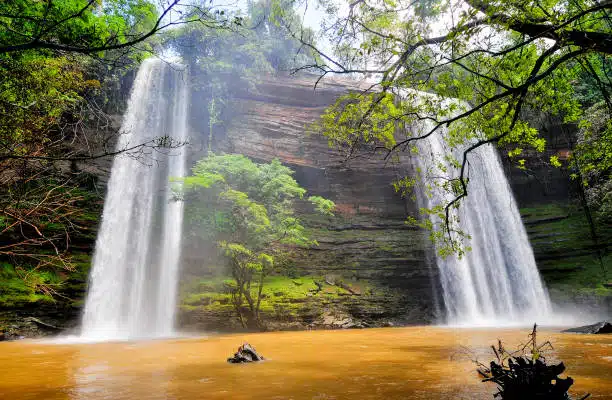
‘Raining seasons are the best!’ says our younger selves. It was always fun to sneak under the rains for a good drenching just before we are caught and placed under a ‘lockdown’ by our parents. Growing up, we gradually lose interest or ‘mature’ out of these fun moments as we try to maneuver our way through life. Once in a while, we hope to take a chill break from our monotonous work schedules to relax and recuperate. And doing this during the wet season usually doesn’t seem like a good idea. However, visiting a waterfall is one of the best locations to choose for a tour during the rainy season. This is due to the fact that in wet weather, a river or stream that is ordinarily a trickle might become a forest of water. Offering a better view and experience of the place. In Ghana, the heaviest rain in the South is from April to June. The lighter rain spans from September to October. Ghana is home to several major waterfalls that are popular tourist destinations, and there are many smaller waterfalls and cascades scattered through the mountainous terrain. Here is a list of places you could visit; Amedzofe Waterfall The Amedzofe waterfall is known for its cool and pleasant climate. The waterfall is located in a town called Amedzofe in the Volta region, a hub for many tourist sites. It is about a 3-hour drive from the capital city of Accra. The waterfall drops from a height of around 35 meters into a lovely pool at the bottom, where tourists can swim and relax. Picnic tables and benches have been made available in the surrounding area for tourists to sit and enjoy the view. Visitors must take a short trek through the lush forest to reach the waterfall, which gives stunning views of the surrounding hills and valleys. Ote Falls Ote Falls is a lesser-known tourist site in Ghana, but it is an excellent choice for anyone seeking a calm and serene vacation. The site is filled with a variety of fauna and vegetation. It’s best to go during the rainy season (April to October) when the waterfall is at its peak. It is advisable to wear sturdy hiking shoes and carry lots of water and sunscreen, as the hike can be steep and strenuous in places. Boti Waterfall Boti Waterfall is a popular tourist site in Ghana and is frequently included in tour packages of the Eastern Region. It takes about a 2-hour drive from Accra to get to the destination. The lower falls cascade around 30 meters into a refreshing pool, while the upper falls cascade down a series of steps and rocks. The waterfall is located in the Boti Forest Reserve, which is home to a diverse range of fauna and flora. Hiking through the forest leads to the waterfall, where visitors can swim, relax, and take in the view. The “Falls Festival” which takes place every August during the rainy season is one of Boti Waterfalls’ distinguishing features. Kintampo Falls Kintampo Falls is located in the Brong Ahafo region, around a 4-hour drive from Accra, Ghana’s capital city. It is a stunning waterfall on the Pumpum River, surrounded by a luxuriant tropical jungle. The waterfall is around 70 meters wide and falls from a height of approximately 25 meters into a big pool at the bottom, where tourists can swim and rest. To reach the waterfall, visitors must take a short walk down a well-maintained trail with steps and handrails. The area’s stunning flora and fauna can be admired along the trip. Wli Waterfall With a total height of approximately 80 meters (262 feet), the Wli waterfall is known as Ghana’s highest waterfall. Hiking through the lush forest for 45 minutes to an hour is normally required to reach the waterfalls. Beautiful scenery and the sounds of birds and other wildlife can be found along the journey. Visitors can swim in the cold pool at the base of the falls, snap photos, or simply relax and enjoy the natural surroundings once they arrive at the waterfall. Wli Waterfall is a popular attraction for both locals and visitors, and it is frequently included in Volta Region trip packages. Tagbo Waterfall Tagbo Waterfall is a beautiful waterfall in Liati Wote in the Volta Region. Surrounded by rainforest, the place provides scenic views for visitors.It is located close to Mount Afadja, the tallest mountain in Ghana. Fuller Falls This beautiful waterfall is located in Kintampo. Though with a comparatively shorter height, its scenic view is worth the visit. It is surrounded by a beautiful forest and offers a place for swimming and picnicking. Other comparatively smaller falls include Asenema Waterfall, Akaa Waterfall, and Tsenku Waterfall. Tips: Pack accordingly, Clothing should be fast drying, Wear comfortable hiking shoes, Luggage should withstand unexpected drenching, take along your sunscreen and repellent, and don’t forget to carry a camera along to capture all the beautiful memories you’ll make on your visit. READ NEXT ON: Keta Lagoon: Ghana’s Largest Coastal Lagoon
Ghanaian Students Win International Excellence Awards in The Gambia

The International Excellence Awards is a prestigious award that recognizes outstanding performance among pre-tertiary students who took part in the West African Secondary School Certificate Examination (WASSCE). The WASSCE is a standardized test taken by students from five West African countries, including The Gambia, Ghana, Liberia, Nigeria, and Sierra Leone. The award is highly regarded due to its international recognition and its focus on academic excellence. It was presented at the 71st Annual Council Meeting held in Banjul, Gambia, this year. The ceremony celebrates the achievements of the top-performing students in the WASSCE. In 2022, two Ghanaian candidates, Alex Opoku Manu and Benjamin Eyram Nana Kwame Degbey, emerged as the top performers in the WASSCE, earning them first and second place, respectively. The third prize went to Odigigbo Chioma Blessing, a Nigerian candidate. The two Ghanaian prodigies were also contestants in the 2022 National Science and Maths competition and were former students of the St. James Seminary SHS in Sunyani. The award is a testament to the hard work and dedication of these exceptional students, who have put their countries on the map and demonstrated the importance of academic excellence. Congratulations to the prize winners! READ NEXT ON: Ghanaian Teen Wins Teen Univers USA and Shows Versatility
Cocoa: Ghana’s Leading Cash Crop
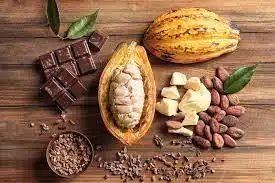
Aside from her gold, and the Black Star, Ghana’s cocoa, imported from Fernando Po (now Bioko, Equatorial Guinea) by Tetteh Quarshie in the year 1878 has served the world’s market with some of the best cocoa beans for many years. Tetteh Quarshie Tetteh Quarshie, born in 1842, is a name that is synonymous with Ghana’s cocoa industry. He was a Ghanaian blacksmith and farmer who made a significant impact on the agricultural sector with the introduction of the cocoa crop. Cocoa beans, also known as Amelonado, were not native to Ghana, but Tetteh Quarshie managed to smuggle some cocoa pods from Fernando Po (now Equatorial Guinea) to Ghana in 1876. He first planted the beans on his farm at Mampong Akuapem in the Eastern Region of Ghana, and the area soon became known for growing a lot of beans. The crop became a commercial product demanded worldwide, and by 1890, Ghana was exporting cocoa beans to Europe and America. Sadly, Tetteh Quarshie died on Christmas day in 1892, but a year after his death, the country started exporting cocoa beans to Nigeria and Sierra Leone. Today, Ghana is one of the world’s largest exporters of cocoa and has earned a reputation for producing some of the world’s best cocoa beans. From the world’s best producer to second best In the early 1960s, Ghana was the largest producer of cocoa globally, accounting for about 40 percent of the world’s cocoa production. However, by the 1980s, production had dwindled almost to the point of insignificance. The drop from an average of more than 450,000 tons per year to as low as 159,000 tons in 1983-1984 was a significant cause for concern. The period between 1983-1984 was a time characterized in Ghana’s history as an unforgettable famine. The dwindled production was attributed to aging trees, widespread disease, bad weather, and low producer prices. Bush fires also destroyed thousands of hectares of cocoa farms in 1983. To launch production, market reforms were instituted, feeder roads were built connecting the fertile yet neglected lands near the border of Ivory Coast, and the government started to focus on extending production services and increased incentives for farmers, such as sponsorship for cocoa farmers and their children, to ignite the interest of young adults. Currently, Ghana has almost a century of experience in producing the highest caliber cocoa beans, earning it a respectable reputation around the world. With an annual production of more than 1,000,000 metric tonnes of beans, the nation currently ranks second among cocoa exporters. Around 3.5% of the nation’s GDP is derived from the cash crop, and at its peak, it accounts for about 66% of the country’s foreign exchange. The Ashanti, Brong Ahafo, Central, Eastern, Western, and Volta regions, where rainfall ranges from 1000 to 500 millimeters annually, are the most prominent cocoa-producing areas. The government has implemented several measures to support the cocoa industry, and the entirely state-owned Ghana Cocoa Board, often known as Cocobod, plays a crucial role in managing the procurement, marketing, and export of all cocoa beans produced in the nation. Cocobod has subsidiaries like the Cocoa Research Institute of Ghana, Seed Production Division, Cocoa Health, and Extension Division, Quality Control Company, and Cocoa Marketing Company. Aside from the cocoa smuggled out of the country, all cocoa produced in Ghana is prized at the same rate to protect from volatile prices on the world market. Expanding other businesses Many global businesses, including Mondelez International, Cargill, ADM Company Limited, Armajaro Ltd., and Hershey, use cocoa from Ghana. Some local buyers of cocoa and product makers are Cocoa Processing Company Limited, Plot Enterprise Gh., Kumankoma Company Limited, Cere Company Ltd., and Delfi Ventures. Among locally produced chocolates gaining prominence on the international scale are Adansi Bar Chocolates, De’ Laugh Chocolates, Kabi Chocolates, 57 Chocolate and Chocoluv Chocolates, Golden Tree, Protem Pride, Protem Nut Tetteh Quarshie, Aspire, and Niche. Cote d’Ivoire –Ghana Initiative (CIGCI), a cocoa cartel widely known as COPEC, was founded by the two world’s largest producers of cocoa. The countries have joint control of 60% of global cocoa production. In conclusion, Ghana’s cocoa industry has come a long way since Tetteh Quarshie introduced cocoa to the country in the late 19th century. Despite the challenges experienced in the 1980s, the government’s support, market reforms, and increased incentives for farmers have led to a resurgence in cocoa production. Ghana’s cocoa industry is a vital contributor to the country’s economy and has earned a reputation for producing some of the world’s best cocoa beans. As a result, many businesses worldwide use cocoa from Ghana to produce their chocolates. READ NEXT ON: History of Bishop Herman College
Beyond The Face: El Anatsui

El Anatsui is a world-acclaimed Ghanaian sculptor with five decades of distinguished career. His earliest works date to the 1970s with about thirty works to his name. He has over the years captivated and provoked a host of international attention and recognition. His work with sculpture and wood carving started as a hobby to keep alive the traditions he grew up with. El Anatsui artworks which are predominantly inspired by African traditional beliefs have been collected by major international museums and featured in Ghana’s first National Pavilion at the 58th Venice Biennale. He is an expert craftsman in building eye and mind-captivating works using wood, clay, metals, and caps of bottles. Some of his famous works are sculpted largely from aluminum bottle caps, these works strike a resemblance to a woven cloth like the Kente. His works have created a new narrative on how creatives can play a pivotal role in the recycling chain, turning trash into treasure. El Anatsui in an interview with October Gallery noted that “The amazing thing about working with these metallic ‘fabrics’ is that the poverty of the materials used in no way precludes the telling of rich and wonderful stories.” His artworks have simple yet striking titles like Sovereign, Freedom, Drying Line, Routes of Discovery, Gli, Peak, Broken Bridges I and II, Gravity and Grace, Ozone Layer, and National Identity Card. Life and Education El Anatsui was born in 1944 at Anyako in the Volta Region of Ghana. He was the youngest of 32 children born to his father. Anatsui was raised by his uncle after his mother died. His first exposure to art was through chalkboard lettering. The sculptor, Vincent Akwete Kofi, served as one of his early influences. After completing his elementary education in the Volta region, he gained admission into the College of Arts, Kwame Nkrumah University of Science and Technology, Ghana. He was granted an opportunity to lecture at the University of Nigeria, Nsukka where he taught as a Professor of Sculpture and subsequently became a Departmental Head of Fine and Applied Art from 1975 until his retirement in 2011. Though born and bred in Ghana, El Anatsui has lived a significant number of his life in Nigeria. He once noted that living outside his country gave him a nomadic mentality that expanded his experiences and prevented him from becoming complacent. El Anatsui has embraced a wide variety of media and addressed a vast array of social, political, and historical issues. Exhibitions Beautifully exhibited pieces of his sculptures have been installed in international museums such as the British Museum in London, the Centre Pompidou in Paris, the De Young Museum in San Francisco, the Metropolitan Museum of Art in New York, Guggenheim in Abu Dhabi, the Osaka Foundation of Culture in Japan, Museum of Modern Art in New York and many other prestigious institutions. The remarkable works of the contemporary artist have been mounted at the façade of international exhibition grounds. In the 2012 Paris Triennale, El Anatsui transformed the entire façade of Le Palais Galliera with his striking work, Broken Bridge. The artwork was also mounted at the Royal Academy of Arts in London in 2013. During the 52nd Venice Biennale in 2007, he also transformed the façade of the Palazzo Fortune by draping it in a shimmering bottle top sculpture, Fresh and Fading Memories. One of his major works, Kindred Viewpoints, also enveloped the façade of El Badi Palace during the 2016 Marrakech Biennale. He displayed his first-ever solo museum exhibition at Meyina Iziko National Gallery in Cape Town. Another solo exhibition includes Gravity and Grace: Monumental Works. This was a touring solo exhibition installed at the Brooklyn Museum in New York, Akron Art Museum in Ohio, Des Moines Art Center in Iowa, and the Bass Museum of Art in Miami, Florida. In 2010, two major touring shows of his work opened on opposite sides of the world. One was his work, El Anatsui: When I Last Wrote to You About Africa, which opened at the Royal Ontario Museum. The second piece was A Fateful Journey: Africa in the Works of El Anatsui at the National Museum of Ethnology in Osaka, Japan. In 2015, a comprehensive survey spanning the last fifty years of Anatsui’s career was celebrated at the premiering of The School (Jack Shainman) with a solo exhibition of the work of El Anatsui in Kinderhook, New York, tagged Five Decades. In 2019, the largest survey exhibition of El Anatsui’s oeuvre, Triumphant Scale, was presented at the Haus der Kunst, Munich Germany. El Anatsui has collaborated with globally recognized artists like Factum Arte, Ablade Glover, Chika Okeke-Agulu, Ozwald Boateng, and Okwui Enwevor. Awards In 1990, he won the Public Prize at the 7th Annual Triennale der Kleinplastik. In 1995, he swooped the Kansai Telecasting Prize at the 6th Osaka Sculpture Triennial. In 1998, the Bronze Prize was awarded to him on the 9th Osaka Sculpture Triennial. In 2008, he was awarded the Visionaries Award at the Museum of Arts and Design (MAD). El Anatsui also received the Prince Claus Award in 2009. Another notable award was the Golden Lion for Lifetime Award by the Venice biennale to acknowledge his artistic contribution to the world 2015. The Royal Academy of Arts, London, also presented the artist with the prestigious Charles Wollaston Award for his work, TSIATSIA – searching for connection, 2013. In 2014, El Anatsui was made an Honorary Royal Academician by London’s Royal Academy, having become the First African Artist appointed to this status. In 2016, he received an Honorary Doctorate from Harvard University and he is also an International Honorary Member of the American Academy of Arts and Sciences. In 2017, he was honored with the Praemium Imperiale Award for Sculpture, by the Japan Art Association, Tokyo, Japan. Impact El Anatsui has been a pivotal figure in the contemporary African art scene, and his work has inspired and influenced a generation of artists who create their own sculptures using similar techniques and materials. These include
Kofi Annan: Ghana’s Unforgettable Legend

Kofi Atta Annan was a distinguished diplomat from Ghana who made a significant impact on the international stage during his tenure as the seventh secretary-general of the United Nations from 1997 to 2006. He was born on April 8, 1938, and passed away on August 18, 2018. Annan was awarded the Nobel Peace Prize in 2001, along with the United Nations, in recognition of his efforts to promote peace and human rights worldwide. Annan was also the founder and chairman of the Kofi Annan Foundation, a non-profit organization dedicated to promoting sustainable development, peace, and security. He served as the chairman of The Elders, an international organization founded by Nelson Mandela to promote peace and human rights, among other causes. Annan had an impressive educational background, having studied economics at Macalester College, international relations at the Graduate Institute Geneva, and management at MIT. He began his career with the United Nations in 1962, working for the World Health Organization’s Geneva office. He went on to hold several key positions at the UN Headquarters in New York, including serving as the Under-Secretary-General for peacekeeping from March 1992 to December 1996. In 1996, Annan was appointed as the UN Secretary-General by the Security Council and later confirmed by the General Assembly. This appointment was significant because he was the first officeholder to be elected from the UN staff itself. Annan’s leadership style was characterized by his ability to bring people together, promote dialogue, and build consensus. He was instrumental in establishing the Millennium Development Goals and promoting peace. Kofi Annan, during his tenure as the Secretary-General of the United Nations, played a pivotal role in reforming the organization’s bureaucracy and implementing measures to combat HIV/AIDS, particularly in Africa. He also spearheaded the launch of the UN Global Compact, a voluntary initiative aimed at promoting sustainable development and corporate social responsibility. However, his failure to expand the Security Council and the controversy surrounding the Oil-for-Food Programme led to calls for his resignation. Despite being largely cleared of personal corruption allegations, Annan faced criticism for not taking more decisive action. After stepping down as Secretary-General, Annan established the Kofi Annan Foundation in 2007, which focuses on international development efforts. In 2012, he was appointed as the UN-Arab League Joint Special Representative for Syria, where he worked tirelessly to find a peaceful resolution to the ongoing conflict. However, Annan resigned from his post due to the UN’s lack of progress in conflict resolution. In 2016, Annan was tasked with leading a UN commission to investigate the Rohingya crisis, which had displaced thousands of people in Myanmar. His efforts to address the humanitarian crisis were widely recognized, and he continued to be a vocal advocate for peace and justice until his passing in 2018. His Early Year and Education Kofi Annan was born on April 8, 1938, in Kumasi, a city located in the Gold Coast, which is now known as Ghana. Annan’s twin sister, Efua Atta, shared the middle name Atta, which means “twin” in Akan, their native language. The siblings were born into a prominent Fante aristocratic family. Annan’s grandfathers and uncle were Fante paramount chiefs, and his brother Kobina went on to become Ghana’s ambassador to Morocco. In accordance with the Akan naming tradition, children are given names based on the day of the week they were born and the number of siblings born before them. Kofi is the Akan name for boys born on a Friday, which was the day of the week Annan was born. Additionally, Annan’s surname, Annan, means “fourth-born child” in Fante, his family’s native language. Annan himself noted that his surname rhymes with “cannon” in English. Annan attended Mfantsipim, an all-boys Methodist boarding school in Cape Coast, from 1954 to 1957. The school’s motto, “dwen hwe kan” (“think and achieve”), left a lasting impression on Annan. He once said that the school taught him that “suffering anywhere concerns people everywhere.” In 1957, the year Annan graduated from Mfantsipim, Ghana gained independence from the United Kingdom and adopted the name Ghana. Annan began his tertiary education in 1958 at the Kumasi College of Science and Technology, which is now known as the Kwame Nkrumah University of Science and Technology. He received a Ford Foundation grant that enabled him to complete his undergraduate studies in economics at Macalester College in Saint Paul, Minnesota, in the United States in 1961. Annan went on to complete a diplôme d’études approfondies (DEA) degree in International Relations at the Graduate Institute of International and Development Studies in Geneva, Switzerland, from 1961 to 1962. After gaining some work experience, he enrolled in the Sloan Fellows program at the MIT Sloan School of Management in 1971-72 and earned a master’s degree in management. Annan was a polyglot who spoke English, French, Akan, and some Kru languages, as well as other African languages. His linguistic abilities were a valuable asset during his tenure at the United Nations, where he served as Secretary-General from 1997 to 2006. His Diplomatic Career Kofi Annan’s illustrious career in the United Nations started in 1962 when he joined the World Health Organization as a budget officer. He then worked as a manager for the state-owned Ghana Tourist Development Company in Accra between 1974 and 1976. In 1980, Annan moved to Geneva to take up the position of head of personnel for the office of the UN High Commission for Refugees (UNHCR). During his time in Geneva, Annan also served as a member of the Governing Board of the International School of Geneva from 1981 to 1983. In 1983, he moved to New York to become the director of administrative management services of the UN Secretariat. Four years later, in 1987, Annan was appointed as assistant secretary-general for Human Resources Management and Security Coordinator for the UN system. In 1990, Annan became Assistant Secretary-General for Program Planning, Budget and Finance, and Control. Two years later, Secretary-General Boutros Boutros-Ghali established the Department of Peacekeeping Operations (DPKO) and appointed Annan as Deputy to then
Celebrating Ghana Month: A Walk Through History

About six centuries ago, the multi-ethnic geography below the Sub-Saharan Desert was set to take a different turn with the visit of nonindigenous explorers. The geographical area, now Ghana, would gradually take a relatively sharp contrast in cultural ideals, notions of slavery, religion, governance systems, dressing, and the adoption of a new language. Let us take a stroll down memory lane. In 1471, the Portuguese, led by Diego D’Azambuja sailed to the shores of Ghana on the instructions of the then Prince of Portugal, Henry the Navigator. The initial intention was to explore new lands, discover a sea route to India and the Far East, and possible trade means. However, I am forced to believe that marveled by the abundance of alluvial gold in rivers, streams, and the presence of raw materials, the Portuguese had gained other candid reasons to form alliances with the people of the coast. First received by the Chief of Edina (Elmina), Nana Kwamena Ansah, the hospitable reception sparked an initial trade alliance with the people of Edina. Aside from the long-existing hospitable nature of the people, possibly due to cultural orientation, the indigenes saw an opportunity to trade for goods absent in those regions. After gradually winning the trust of the people, Castelo de São Jorge da Mina (St. George of the Mine Castle) was erected in 1482 by the Portuguese. Due to the scramble for African territories by the Europeans and the desire to extend their empires, the Portuguese were ousted by the Dutch from Holland in 1642. By then, the British, led by Captain Windham, had already crept onto the land in 1533 steadily gaining grounds that would mark them in history as the last European country to leave these shores. By this time, the geographical territory, especially the Southern Kingdoms was adjudged, Gold Coast. The Swedes also formed alliances with the coasters on their arrival in 1640 and the Danes from Denmark in 1660. All these alliances created ‘soft’ grounds for colonization to set in. How Ghana’s Colonization Started and Ended Colonization in Ghana began in the late 15th century when Portuguese explorers first arrived on the country’s coast. They established trade relations with the local people and set up forts along the coastline. The Dutch and the British soon followed, and by the 19th century, the British had gained control of the region. In 1874, the British declared the Gold Coast (as Ghana was then known) a British colony, and it remained under British colonial rule until it gained independence in 1957. During the colonial period, the British imposed their political, economic, and social systems on the Gold Coast, and they used the region as a source of raw materials for their industries. In the early 20th century, the Gold Coast saw an increase in nationalism and anti-colonialism movements. The most significant of these was the United Gold Coast Convention (UGCC), founded in 1947, which campaigned for self-government and eventually led to independence. On March 6, 1957, the Gold Coast became the first sub-Saharan African country to gain independence from colonial rule, and it was renamed Ghana. Ghana’s first president, Kwame Nkrumah, led the country through its early years of independence and worked to improve the country’s infrastructure and economy. READ NEXT ON: The Monumental Independence Arch
Key Lessons for Aspiring Entrepreneurs: Insights from Alhaji Aliko Dangote

For the past twelve years, Alhaji Aliko Dangote has topped the chart as Africa’s wealthiest billionaire with a credit of $13.5 billion to his name, despite a $400m drop in his fortune. According to Forbes Billionaires, Dangote ranks as the 136th wealthiest man in the world.The business magnate and investor established his business empire, Dangote group, in 1981 in the sales of commodities like pasta, cement, sugar, salt, flour, steel, and for a few years now, oil and gas. Though he owns Sub-Sahara’s largest sugar refinery, most of his fortune is accrued from his cement industry with the household name, Dangote Cement. His company serves countries like Benin, Senegal, Ethiopia, Ghana, South Africa, and Zambia. Dangote started his business with a capital loan from his Uncle. He comes from the upper class and a line of entrepreneurs, the Dantata family. Aliko Dangote attributes his wealth and success to more than his family lineage. Perhaps, being born into the upper class or hailing from a line of entrepreneurs is not the only surety to becoming a successful entrepreneur. Here are some points to note as an entrepreneur; Be consistent with your vision In an interview, Dangote stated his long-standing decision not to dabble in just any venture. Business can be fraught with inescapable challenges but he chose to be focused and consistent with what he called ‘his game’. The icebreaker is to focus on the thing you know best and build a depth of knowledge and experience in that area. Access the needed information to make the right decision It is expedient to gather all relevant information about a business before venturing into it. In an interview, Dangote stated that when he was ready to venture into manufacturing, he and his team decided to understand why most manufacturing companies were failing. In 1995, they invited a consulting firm, then Arthur Anderson, to help ferret out the cause of failure in manufacturing. They uncovered two reasons, lack of electricity and inconsistent government policy. So they decided to generate electricity independently and remain friendly with the government of the day. Thus having the needed knowledge can help businesses to avoid certain setbacks. Strive to be a good leader and a good listener Take into account the suggestions and opinions of team members. Dangote states that the right team is needed for anyone to make it. As a leader, it might be difficult to open up about your shortfalls, but it is a fact that your knowledge and experience are limited and you need people’s time, and intelligence to make progress. Do the things you understand Accumulate adequate information about any business before venturing into it. Business ideas should be given a clear and thorough thought before indulging. Go further to develop a deeper knowledge of the industry. You can leverage your existing knowledge and skills to achieve your goals more effectively. This can help you build confidence and improve your performance over time, as you gain more experience and expertise in your business. Your name is your most valuable asset Your name is your most valuable asset because it represents who you are and what you stand for. Your name is your personal brand, and it is the way people will remember you and your reputation. It is important to protect and maintain your name by being honest, reliable, and consistent in your actions and behavior. Be honest in your business dealings and do not allow short-term gains to cause you to dent your image. Consolidate before diversity Dangote stated in an interview that “It is important to build a strong foundation before expanding or diversifying into new areas. It is better to focus on mastering one skill or area of expertise rather than trying to do too many things at once. By consolidating and becoming proficient in a particular area, individuals or businesses can establish a solid reputation, build a loyal customer base, and develop a strong internal infrastructure. It is also important to keep up with trends.” The tenacity of purpose is supreme Success takes time. It takes a step-by-step process, coupled with hard work behind the scenes. Dangote advises young entrepreneurs to start small and dream big. He further states that success is not just about having a clear vision or setting achievable targets, but also about staying committed and persistent in the face of challenges and setbacks. Individuals who possess a tenacious sense of purpose are able to stay focused on their goals, even in the face of obstacles or distractions, and are willing to put in the hard work and effort necessary to achieve success. READ NEXT ON: From a few shillings to a Global Business Empire: The inspirational story of Esther Afua Ocloo
Valentine’s Day Is All About Love, But Was It Always That Way?

Over 1500 years ago, Valentine’s Day was first celebrated in memory of a martyred Christian. While the festival’s origins are rooted in both pagan and religious traditions, it has now become synonymous with love. Back in ancient Rome, February was considered a month of love, but the celebrations were far from the romantic notions of today. Rather than exchanging chocolates and flowers, animals were slaughtered, and young men would whip young women while naked- not exactly a fun season! It’s believed that the romantic connotation of Valentine’s Day was popularized by poetic writers like Geoffrey Chaucer and Shakespeare. St. Valentine himself supposedly wrote the first “valentine” to a young girl he tutored and fell in love with while imprisoned for his crimes. The day has been associated with various martyrdom stories, with one early tradition suggesting that St. Valentine restored sight to the blind daughter of his jailer. Modern Valentine’s Day is associated with romantic love, which flourished during the 14th and 15th centuries with the notion of courtly love. In the 18th century, it became a popular occasion for couples to express their love through gifts such as flowers, confectionery, and greeting cards. Today, Valentine’s Day symbols include the heart-shaped outline, doves, and the winged Cupid figure. In fun facts, the first Valentine’s card dates back to 1415 when the Duke of Orleans sent a card to his wife while he was imprisoned in the Tower of London. The earliest known letter of the “Valentine” kind is a letter from Margery Brews, a Norfolk woman, to her cousin John Paston in 1477. Whether you celebrate Valentine’s Day or not, love has connected humans for centuries, and it’s not relegated to just one day. As Chaucer’s poem suggests, even the birds defer the decision of choosing their mates until next year. READ NEXT ON: Don’t Kill Yourself This Valentine’s Day
Tips To Looking Supple During The Harmattan Season

The Harmattan season in the West African region is characterized by dry, cold, and dusty wind from the Sahara Desert. The skin is generally affected the most because it is the most exposed. Some common effects are tight and dry skin, skin allergies, skin rashes, dull hair, cracked heels, and chapped lips. The harshness of the season makes it expedient to be intentional about taking care of your skin. Here are steps to follow on how to take care of your skin. Stay hydrated. Drink lots of water or fluid to keep your body hydrated since the rate of dehydration is faster in this season. This will also help to flush out impurities and keep your skin supple. Drink honey, lemon, and ginger dissolved in warm water to soothe any throat irritation you might encounter. Moisturize, moisturize, moisturize. Your body and hair need a lot of moisturizing oils this season. It is recommended to leave your body damp before moisturizing since damp skin absorbs products easily. Natural oils, lightweight hydrating moisturizers, humectants, and occlusive moisturizers are highly recommended. Protect your face by cleansing regularly using a wet towel or an alcohol-free face cleanser and moisturizing frequently. A lip balm, hand sanitizer, and hand moisturizer will always come in handy. Exfoliate. Regularly exfoliating the skin with natural scrubs which contain vitamins C and E will help remove dead and dry skin. This will leave the skin fresh, moisturized, and breathable. Baths. Avoid hot showers as hot water strips the skin of its natural oil barrier and causes more dryness. Wear protective clothing. Due to the cold and dryness, the use of warm or thick protective clothing will ensure that the skin is protected from the harshness that comes with harmattan. Wearing of nose masks will also protect the nostrils from dust particles, especially when going to places prone to dust. This will help reduce cold and also avoid triggering any asthmatic attacks or allergies. An extra tip for my ladies. It is advisable to avoid makeup but if you must wear makeup, prep your skin with a good moisturizer. This will avert any incidence of applying makeup on a flaky skin. Switch your matte foundation for a hydrating foundation that settles smoothly over your skin. It is recommended to also choose a lip gloss or a lip balm over lipstick. Wiping off your makeup at the end of the day is necessary to avoid acne inflammation. READ NEXT ON: Do New Year Resolutions Have To Be ‘New’?
Do New Year Resolutions Have To Be ‘New’?
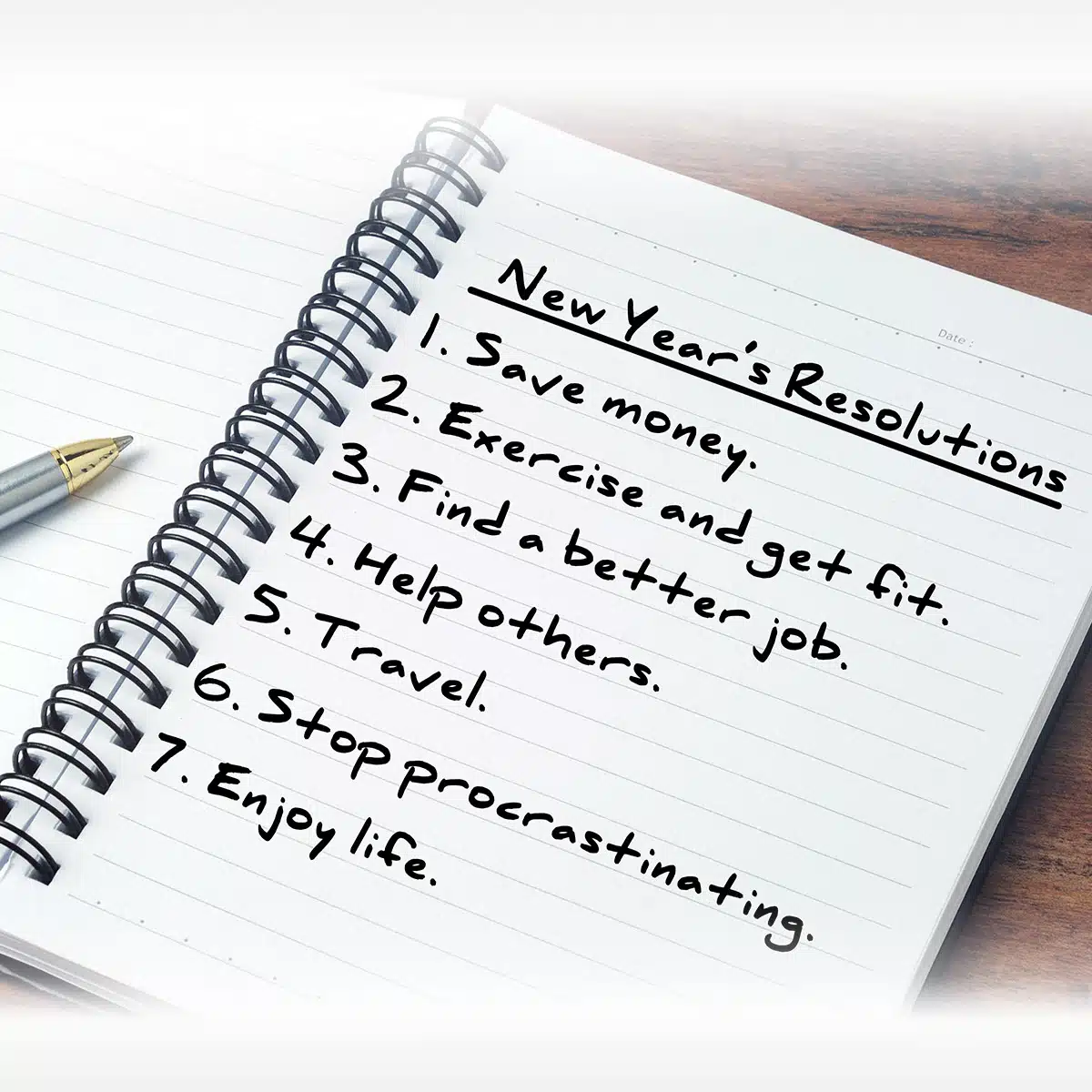
It is a common trend to find people setting new goals and making huge plans at the beginning of the year. What we commonly call new year resolutions. Undoubtedly, this is a great way to start the year. It shapes your perspective on what you want to achieve within the year and how you can achieve them. However, what if resolutions do not have to be new goals or a new vision? Usually, in this period, many people ditch their previous resolutions, whether finished or unfinished to take up new ones. To achieve any goal, there is a need for focus and consistency in order to get the desired results. If you are planning to ditch all old plans, take a breather. Access your progress, restrategize, and apply consistency in achieving the unfinished ones. However, take up a new goal when you feel a need. Here are some areas to target as you pen down your resolutions. Health. As the saying goes, health is wealth. This can include exercising, eating healthy, and getting enough rest. Almost all resolutions can be achieved when one is in good health-physically, mentally, and emotionally. Spirituality. If you are a religious person, getting in tune with God can be very therapeutic in jeering you towards your goals. Research has found that people who get in tune spiritually usually have a more peaceful approach toward their goals. Finances. Gaining financial knowledge and learning how to effectively manage and grow your finances is one key aspect to target. Read books, and articles or watch videos that can equip you with the needed knowledge. Relationships. Whether with family, colleagues at work, or your lover, relationships are significant to our well-being. According to research, forming healthy relationships can be a buffer against stress and depression. It can also boost your desire to work on yourself and be a better person consequently jeering you towards your goals. Always remember, the aim is to start, stick to and accomplish your goals or resolutions. READ NEXT ON: Is the 8 hours of sleep rule a myth?