Ghanaian Cuisine: Omo Tuo

Omo tuo, known as tuwo shinkafa in the Northern region of Ghana, has its origins in the Hausa culture but has gained popularity throughout the country. The term “tuwo” likely corresponds to various types of fufu or dumplings made from grain flour. For instance, tuwo zaafi refers to a dumpling made from millet or corn and cassava flour, while tuwo masara is a cornmeal dumpling. In Northern Nigeria, tuwo shinkafa is typically prepared using ground rice instead of whole rice that is softened and pounded. If you’re interested in making omo tuo, here’s a simple recipe to follow: Ingredients: Instructions: By following these steps, you can enjoy a delicious serving of omo tuo with any soup of your choice. This versatile dish, deeply rooted in the Hausa tradition, has found its way into the hearts and palates of Ghanaians across the country. READ NEXT ON: Ghanaian Cuisine: Tuo Zaafi and Ayoyo Soup
8 Ethics and Regulations in Influencer Marketing

Ethics and regulations in influencer marketing have become increasingly important topics as the industry continues to experience rapid growth and evolution. Influencer marketing, which involves collaborating with individuals who have a significant online following to promote products or services, has proven to be a powerful tool for brands to reach their target audiences. However, the rise of this marketing strategy has brought forth ethical considerations and the need for proper regulations to ensure transparency, authenticity, and consumer protection. One of the primary ethical concerns in influencer marketing is the issue of transparency and disclosure. Influencers have a responsibility to disclose their relationships with brands and be transparent about sponsored content. This means clearly and prominently informing their audience when a post or video is a paid partnership or includes any form of compensation. The disclosure should be easily understood by the average consumer and should not be hidden or buried within the content. Transparency is crucial for maintaining trust between influencers and their followers, as it helps consumers to be aware of any potential biases or conflicts of interest. Authenticity and honesty are also vital ethical considerations in influencer marketing. Influencers should strive to maintain authenticity in their content and avoid misleading or deceptive practices. They should only promote products or services that align with their values and that they genuinely believe in. Presenting honest opinions and experiences contributes to building credibility and trust with their audience. When influencers engage in dishonest practices, such as promoting products they do not genuinely use or enjoy, it can lead to a breakdown of trust and credibility, which can have long-term negative effects on their personal brand. Accurate representation of products or services is another important ethical aspect of influencer marketing. Influencers should be mindful of the claims they make about the products they promote. Any statements or representations should be truthful and supported by evidence. Misleading claims can not only harm consumers who may purchase products based on false information but also damage the reputation of both the influencer and the brand. Influencers should take care to thoroughly research and understand the products or services they are endorsing to ensure that they are making accurate claims. Influencers also have a responsibility to protect vulnerable audiences. This includes being cautious when promoting products or services to children or individuals with specific vulnerabilities. Extra care should be taken to ensure that the content is appropriate and does not exploit or manipulate these groups. For example, influencers should be cautious about promoting potentially harmful products or excessive consumption to impressionable audiences. Respect for consumer privacy is another key ethical consideration in influencer marketing. Influencers should be mindful of consumer privacy and data protection regulations. They should handle personal information responsibly and obtain proper consent when collecting or using consumer data for marketing purposes. This includes being transparent about how consumer data is used, stored, and shared. Governments and regulatory bodies are increasingly recognizing the need to regulate influencer marketing to protect consumers and ensure fair practices. These regulations may include guidelines on disclosure practices, content accuracy, and data privacy. Influencers and brands should stay informed about relevant laws and regulations in their respective jurisdictions to ensure compliance. It is important for the industry to engage in self-regulation as well and develop ethical standards that go beyond legal requirements. Brands also share responsibility in maintaining ethical practices in influencer marketing. They should collaborate with influencers who align with their brand values and encourage ethical behavior. Contracts or agreements between influencers and brands should clearly outline expectations, disclosure requirements, and any exclusivity arrangements. By fostering partnerships with ethical influencers, brands can ensure that their marketing efforts align with their values and resonate with their target audiences. Influencer marketing associations and organizations also play a crucial role in developing and promoting ethical standards within the industry. They can provide guidelines, training, and resources to influencers and brands to foster responsible and ethical practices. By establishing industry-wide standards, these associations can help ensure that influencer marketing continues to be an effective and ethical form of brand promotion. In conclusion, ethics and regulation in influencer marketing are essential to ensure transparency, authenticity, and consumer protection. Influencers, brands, and regulatory bodies all play a role in maintaining ethical practices and upholding the trust of audiences. By prioritizing transparency, honesty, accurate representation, protection of vulnerable audiences, and respect for consumer privacy, influencer marketing can continue to be an effective and ethical marketing strategy. As the industry continues to evolve, it is crucial for stakeholders to actively engage in ethical discussions, self-regulation, and adherence to applicable regulations to foster a positive and responsible influencer marketing ecosystem. WHAT’S OUT THERE: Social Responsibility And Ethics In Influencer Marketing READ NEXT ON: Balancing Content Creation and Curation in Social Media
7 Ways to Recognize and Avoid Toxic Workplace Cultures during Job Interviews

Recognizing and avoiding toxic workplace cultures during job interviews is essential for ensuring a positive and healthy work environment. By being attentive and proactive, you can identify warning signs and make informed decisions. Here are some valuable strategies to help you navigate this important aspect of the job search process: Research the company Conduct thorough research about the company’s values, mission, and work culture before the interview. Start by reviewing their website, social media profiles, and any news articles or press releases about the organization. Look for any patterns or recurring complaints that could indicate a toxic culture. Additionally, consider reaching out to your professional network to gather insights or experiences from individuals who may have worked or interacted with the company. Pay attention to the interview process Observe how the interview process unfolds. Take note of how you are treated by the interviewers and other staff members you encounter. Is the communication clear, respectful, and prompt? If you encounter unprofessional behavior, lack of transparency, or disrespectful treatment during the interview process, it could be indicative of a toxic culture. Remember that the interview process is an opportunity for the company to make a positive impression on potential employees, so any concerning behavior should be taken seriously. Ask insightful questions Use the interview as an opportunity to ask questions that will give you insights into the work environment and company culture. Consider asking about the company’s approach to employee well-being, work-life balance, career growth opportunities, and how they handle conflicts or challenges within the team. By asking these questions, you can gauge the organization’s priorities and their commitment to fostering a positive work environment. Nonverbal cues Pay attention to the nonverbal cues during the interview. Notice the demeanor of the interviewers and their body language. Are they engaged, respectful, and supportive? Do they actively listen to your answers and ask follow-up questions? Nonverbal cues can provide valuable information about the company culture and how they interact with their employees. Discuss company values and culture Take the opportunity to ask the interviewers about the company’s core values and how they are reflected in the workplace. Inquire about their team dynamics, communication styles, and how they foster a positive work environment. Their responses will provide insights into the cultural aspects of the organization. If the interviewers struggle to articulate or provide concrete examples of their company values in action, it may be a sign of a misalignment between stated values and actual practices. Trust your instincts Trust your gut feelings about the company and the people you interact with during the interview. If something doesn’t feel right or if you sense tension, negativity, or a lack of alignment with your values, it’s important to take those feelings seriously. Often, your intuition can provide valuable insights into the overall atmosphere and culture of an organization. Seek external perspectives In addition to your own research, consider seeking external perspectives on the company. Reach out to your professional network or connections who may have insights or experiences with the company or industry. They can provide valuable information and help you make a more informed decision. Remember, toxic workplace cultures can have a detrimental impact on your mental and physical well-being, job satisfaction, and career growth. It’s crucial to prioritize your own needs and values when evaluating potential job opportunities. By conducting thorough research, asking insightful questions, and trusting your instincts, you can increase your chances of identifying and avoiding toxic workplace cultures during job interviews. WHAT’S OUT THERE? 5 Ways to Recognize a Toxic Work Culture During an Interview READ NEXT ON: 5 Importance of Setting Boundaries in a Toxic Work Environment
History of the Fante People

The Mfantsefo or Fante people, also spelled as Fanti, belong to the Akan ethnic group. They primarily inhabit the coastal regions of Central and Western Ghana. In addition to their local settlements, Fante communities have spread to other regions such as Gambia, Liberia, and Angola, primarily due to fishing activities. Prominent Fante cities in present-day Ghana include Kasoa, Winneba, Agona Swedru, Tarkwa, Oguaa (Cape Coast), Edina (Elmina), Mankessim, Sekondi, and Takoradi. Like all Akans, the Fante trace their origins to Bono state. Initially, the term “Fante” referred to “the half that left” and separated from other Akans, settling initially in Mankessim. The Fante comprises various states, including Agona, Ahanta, Kurantsi, Abura, Anyan, Ekumfi, Nkusukum, Ajumako, and Gomoa. The Fante, like other related Akans, can trace their ancestry back to the ancient Sahara within the Old Ghana Empire. From there, they migrated southward to Techiman in the Brong Ahafo region, and it was from this point that their three great leaders – Oson, Odapagyan, and Obrumankoma – led them further south, eventually settling in Mankessim. Mankessim serves as the historical and spiritual capital of Mfantseman. The Fante people constitute one of the largest Akan groups, alongside other groups like the Ashantis (Asantefo), Akuapems, Akyems, Bonos, Kwahus, Baoules, Nzemas, and Ahantas. Despite facing constant conflicts with the Ashanti Empire and the Dutch during the mid-1800s, the Fante have successfully maintained their autonomy to this day. They have fought numerous wars, both to protect their northern territories from Ashanti incursions and against the Dutch and English. 1The current Fante population is estimated to be around 6 million, making them the second largest Akan subgroup and comprising approximately 13% of Ghana’s total population. In terms of inheritance and succession to public office, the Fante follow the tradition of matrilineal descent, which is common among the Akan people. However, Fante males of fighting age traditionally belong to their father’s Asafo company. When the Portuguese arrived in the 15th century, the Fante prevented them from venturing inland and leased properties to the Portuguese for trading purposes. However, disagreements arose between the Fante and the Portuguese over rules and regulations, leading to skirmishes and battles. As a result, the Fante expelled the Portuguese and subsequently encountered the Dutch and the British. The Fante acted as intermediaries between the interior regions and the British and Dutch traders along the coast, which brought them wealth and prosperity. In the early 18th century, the modern Fante Confederacy was formed with the objective of establishing themselves as a respected nation and securing the withdrawal of Europeans from Fante lands. The Fante already had a sophisticated system of federal governance, with various states existing in an alliance. Each Fante state is led by a Paramount Chief, but during times of war, they unite under a Union army, often commanded by the Paramount Chief of Abura. Faced with strong resistance, the Portuguese, Germans, Swedes, and Danes gradually abandoned their trading forts in Mfantseman. The Dutch, however, chose to stay, leading to numerous conflicts with the Fante. Weakened by constant battles against the Ashanti and the Dutch, the Fante Confederacy signed the bond of 1844 with the British. In response, the British relocated the capital of the Gold Coast from Cape Coast to Accra. The formation of the modern Fante Confederacy was a response to European attempts to colonize large areas of present-day Ghana. The 1844 bond ensured the Gold Coast’s eventual independence from colonial rule, achieved peacefully a century later. Several Ashanti-Fante Wars ensued as the Ashanti sought direct trade routes to the coast. On certain occasions, the Fante received support from the British, although the latter aimed to weaken the strong Fante confederation established between 1868 and 1872, perceiving it as a threat to their coastal hegemony. The British and the Dutch took opposing sides during the Ashanti-Fante conflicts, with the British supporting the Fante and the Dutch supporting the Ashanti. While the Mfantsefo are generally known for their peaceful nature, they rally together for common defense during times of war. As a result of wars with the Dutch and the Ashanti, the combined strength of the Fante Union Army exceeded thirty thousand men in 1844. Under the leadership of Amfo Otu, the Paramount Chief of Abura, they even laid siege to Elmina, their own town, and the European castle within it, ultimately expelling the Dutch from their stronghold in Elmina. READ NEXT ON: History of the Guan People of Ghana
Ghanaian Cuisine: Tuo Zaafi and Ayoyo Soup

Discover the irresistible flavors of Tuo Zaafi and Ayoyo Soup, the beloved Ghanaian delicacy that has captured the hearts and taste buds of people nationwide. This nutritious dish, also known as TZ or Saakbo in Gruuni, is a staple on the streets of Accra. Tuo Zaafi is a delightful combination of soft and less sticky corn flour, accompanied by a variety of special vegetable leaves like ayoyo, Aleefi, Kuukar, Okra, and Shuray. This mouthwatering dish is elevated with the rich flavors of dawadawa, smoked herrings, and tender goat or cow meat. Originating from the Hausa language, the name Tuo Zaafi translates to “hot stirring” and reflects the warmth and satisfaction it brings. This culinary delight is not limited to Ghana alone but is also cherished in neighboring West African countries like Nigeria, Mali, Burkina Faso, and Niger. Today, Tuo Zaafi has found its place in restaurant menus, symbolizing its widespread acceptance among Ghanaians from different regions. While traditionally enjoyed as dinner, some enthusiasts have embraced it as a favorite breakfast or lunch option. How to Prepare Tuo Zaafi and Ayoyo Soup Tuo Zaafi: Ayoyo Soup: If you’re already a lover of this delightful dish, keep enjoying and promoting the rich flavors of Ghana. For those who haven’t yet joined the Tuo Zaafi group, and if there are no medical reasons holding you back, we hope this description has stirred your appetite to give it a try. Join us as we continue to celebrate Heritage Month. Remember, Tuo Zaafi is best enjoyed hot and garnished with shea butter. Let your taste buds embark on a flavorful journey! READ NEXT ON: Ghanaian Cuisine: Waakye
Beyond the Face: Theresa Oppong-Beeko

Ghana’s real estate industry is traditionally dominated by men, but Theresa Oppong-Beeko has defied the odds and emerged as a trailblazing entrepreneur in the sector. With her deep understanding of the Ghanaian housing market and demand, she founded the Manet Group, which encompasses various ventures such as Manet Housing (a real estate development firm), Manet Beach Paradise (a three-star Hotel Resort), Manet Construction Limited (a Civil Engineering Company), and Manet Towers Ltd. (developers of the Twin Tower edifice in Accra’s Airport City). Theresa Oppong-Beeko’s journey began after she obtained a Bachelor of Arts degree in Political Science and Sociology from the University of Ghana, Legon, in 1985. Initially venturing into fishing as her first business, she encountered a setback that left her with a debt of US$2.5 million at the age of twenty-five. Driven by a thirst for knowledge, she returned to the University of Ghana to pursue a Master’s program in Business Administration, where she excelled and was recognized as the Best Marketing Student in 1990. It was during this time that her passion for construction and building projects began to take shape. In 1994, Theresa established Manet Housing Limited, which has since constructed over 1,800 homes. Subsequent development projects followed, including the Manet Gardens, Manet Cottage annex, and the Manet Ville in East Airport. Her real estate portfolio continued to expand with properties such as Manet Palms in East Legon, Manet Court in East Airport, Manet Towers in Airport City, and Manet Paradise in Ada. In 1998, Theresa Oppong-Beeko founded Manet Hotels Limited, acquiring a beach resort in Ada and transforming it into a thriving three-star hotel known as Manet Paradise & Beach Resort. The resort offers various recreational and leisure facilities, including aqua sports and marlin fishing. One of her most iconic constructions is the Manet Twin Towers, a US$22 million high-rise office complex in Airport City. Commissioned in 2010, the Twin Towers housed UT Bank and Vodafone, symbolizing Theresa’s aspiration to claim the number one position in the industry. Continuing her entrepreneurial journey, she completed Manet 3 in October 2016. This ten-floor building, with an extended north wing providing commercial lease space of 7,600 square meters, also features a 12,000 square meter car park. Integrity, transparency, open communication, hard work, and prudent financial management are the core values embraced by the Manet Group, as stated on their website. Theresa Oppong-Beeko has received numerous accolades in recognition of her accomplishments, including Property Personality of the Year, Woman of the Year Award, West Africa Hall of Fame Security Excellence Award, Ghana Property Express Property Personality of the Year, TNG Corporate Merit Awards, Ghana’s Indigenous Woman Entrepreneur of the Year, and Africa’s Most Influential Woman in Business and Government. Theresa’s perseverance has been instrumental in her success as an entrepreneur, navigating the challenges that often accompany such ventures. Currently, she holds the second position among Ghana’s richest women, with a net worth of US$420 million. Her dedication and achievements have not only contributed to the real estate industry but have also played a significant role in addressing Ghana’s housing shortage. READ NEXT ON: Beyond the Face: Patricia Poku-Diaby
BridgeView Resort

Welcome to BridgeView Resort, the enchanting Santorini of Africa, located in Ghana. This extraordinary destination has quickly become one of the most sought-after places to visit, whether you are already in Ghana or planning your next trip. Nestled in Ghana’s Eastern Region, BridgeView Resort awaits you, just a scenic 90-minute drive away from Accra. As you embark on this picturesque journey, the anticipation builds, and your excitement grows. Arriving at BridgeView is like stepping into a dream. The breathtaking Akosombo mountains encircle the town, their majestic peaks reaching for the sky. Beyond them lies the vast expanse of Lake Volta, its tranquil waters stretching as far as the eye can see. This combination of natural beauty creates an awe-inspiring backdrop that surrounds the resort. The architecture of BridgeView Resort is a testament to elegance and style. The resort seamlessly blends modern design with traditional elements, creating a harmonious atmosphere that exudes tranquility. Every corner of the resort is meticulously crafted, with attention to detail that will leave you in awe. Once you set foot on the resort grounds, you will be greeted by lush greenery, vibrant flowers, and the refreshing scent of nature. The landscape is meticulously manicured, creating a serene oasis that invites you to unwind and relax. The resort seamlessly merges with its surroundings, embracing the beauty of Ghana’s natural wonders. BridgeView Resort offers a myriad of experiences for every type of traveler. Whether you seek adventure or relaxation, you will find it here. Spend your days lounging by the pristine pool, sipping on a refreshing cocktail while soaking up the warm Ghanaian sun. Or perhaps you prefer to explore the nearby mountains, embarking on exhilarating hikes and witnessing breathtaking vistas. For water enthusiasts, Lake Volta beckons with its calm waters, perfect for kayaking, paddleboarding, or even a leisurely boat ride as you admire the stunning landscape. When it comes to accommodations, BridgeView Resort leaves no stone unturned in providing luxury and comfort. From elegant rooms with panoramic views to spacious villas with private pools, every option is designed to create an indulgent experience. Each room is meticulously decorated, reflecting the resort’s commitment to creating a serene and inviting atmosphere. Indulge your taste buds at the resort’s world-class restaurants, where culinary delights await. From tantalizing local flavors to international cuisine prepared by skilled chefs, every meal is a gastronomic journey that delights the senses. The resort’s attentive staff ensures that your dining experience is nothing short of exceptional. As the day winds down, treat yourself to a visit to the spa, where skilled therapists offer a range of rejuvenating treatments. Let the stresses of everyday life melt away as you indulge in a massage or immerse yourself in a blissful wellness ritual. At BridgeView Resort, every moment is an opportunity to immerse yourself in the beauty of Ghana. Whether you seek adventure, relaxation, or simply a place to reconnect with nature, this enchanting resort provides the perfect setting. Come and discover the magic of BridgeView, where breathtaking landscapes and unparalleled hospitality combine to create an unforgettable experience. NEXT PLACE TO VISIT: Prempeh Jubilee Museum
From Undergrads to Lifelong Love: Kwame and Mavis Ntim’s Enduring Story

Amidst the vibrant lecture halls of the University of Cape Coast, where dreams took shape and ambitions were fostered, a serendipitous encounter between two individuals would lay the foundation for an extraordinary voyage. Kwame Ntiamoah Ntim found himself captivated by a young woman who stood out from the bustling crowd with her backpack. Intrigued, he initiated a conversation with her after class, unknowingly setting in motion a destiny-altering moment. Mavis Ababio Amponsah, the young lady in question, possessed an enchanting allure that instantly captured Ntim’s attention. As they conversed, Kwame discovered that Mavis was a devout Christian, a quality he had long sought in a partner. Having completed Bible school prior to university and being involved in ministry, Kwame believed that their shared faith would form a firm bedrock for their relationship. Both Kwame and Mavis were pursuing their undergraduate degrees in B.Ed. Social Science, specializing in Geography and Economics. Kwame harbored aspirations of becoming a diplomat while continuing his ministry work, while Mavis aimed to carve out a distinguished path as an academician and counselor. Their shared dedication to their respective fields fostered a sense of harmony and mutual understanding between them. Their connection blossomed, and fate intervened once more during Kwame’s visit to the Kwame Nkrumah Hall, where he resided. In a stroke of serendipity, he crossed paths with Mavis once again. Seizing the opportunity, Kwame obtained her contact information, and their bond deepened with each passing day. They decided to embrace matrimony during their first year of their MPhil program, a testament to their unwavering commitment and profound love for one another. Juggling their studies together, albeit pursuing different programs, presented its fair share of challenges. While their undergraduate studies allowed for occasional joint studying, their research interests diverged during their MPhil program. Moreover, life presented additional obstacles along the way. Mavis became pregnant, while her husband had to embark on a journey to the United States for a few months. Nevertheless, they persevered, refusing to yield. They attributed their resilience to the grace of God, which sustained them throughout their academic journey. Managing the financial burdens of being a couple pursuing their education demanded resourcefulness and familial support. With the assistance of their families and engaging in small entrepreneurial ventures, they overcame these hurdles. Their unshakeable faith in Jesus guided them, endowing them with the strength to endure. Beyond their educational pursuits, Kwame and Mavis cultivated other passions. Kwame, a missionary, entrepreneur, and investor, penned a book titled “Mysteries of Music,” a testament to his creative spirit and profound love for music. Meanwhile, Mavis aspired to make significant contributions to academia and counseling, envisioning a future where her expertise would positively impact countless lives. Their tale embodies perseverance, love, and shared dreams. The couple had the opportunity to serve their alma mater during their National Service. Kwame worked as a Research and Administrative Assistant at the Office of International Relations, while Mavis served as an Administrative Assistant at the Institute of Education, Planning, and Administration. These experiences ultimately influenced their decision to pursue MPhil programs at the same institution. As they embark on their journey as a married couple, Kwame and Mavis hold steadfast to their dreams. Mavis yearns to pursue her Ph.D., aspiring to secure a scholarship in the near future. Meanwhile, Kwame seeks to work with the Ministry of Foreign Affairs and Regional Integration while continuing his active ministry work. Together, they remain resolute in their pursuit of a life filled with purpose and devotion. READ NEXT ON: 10-year-old Aseda Bekoe shines at Climate Benefit Ball
History of the Guan People of Ghana
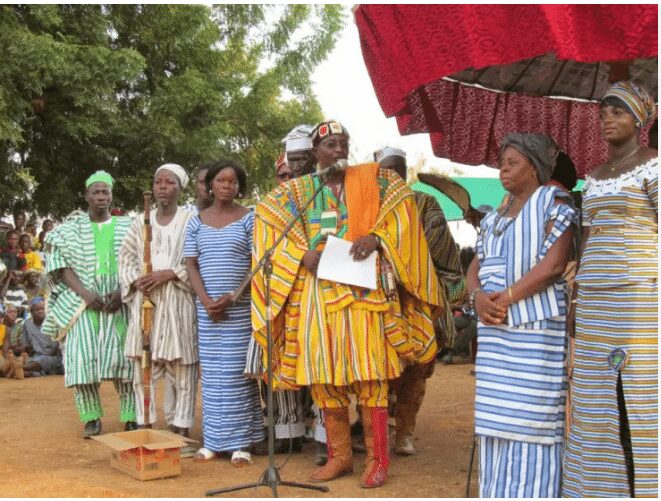
The Guan people, an ethnic group scattered across various regions of Ghana, play a significant role in the country’s cultural fabric. They are present in regions such as Krachi, Nkonya, Gonja, Anum, Larteh, Akposo, Nawuri, Ntsumburu, and more. Speaking languages belonging to the Guan branch of the Niger-Congo language family, they constitute approximately 3.7% of Ghana’s population. Historically, the Guans are believed to be the earliest settlers in what is now modern-day Ghana, having migrated from the Mossi region of present-day Burkina Faso around 1000 A.D. Over time, the Guan languages have been influenced by other major languages spoken in Ghana, depending on the specific location of each Guan tribe. For instance, Guan communities in the Eastern region consist of Anum, Boso, Larteh, Okere, and Kyerepong, while those in the Oti Region include Krachi, Buem, Nkonya, Likpe, Santrokofi, Akpafu, and others. In the Volta Region, Guans such as Avatime and Logba can be found, while in the Central Region, there are Guan communities like Efutu, Awutu, Senya, and Bawjiase. The Gonja people reside in the northern parts of Ghana, as well as parts of Brong Ahafo, Bono, and Ahafo regions. Additionally, the Nawuri people occupy areas in the northern parts of North and Oti Regions, specifically in the eastern end of the Salaga district, along the west bank of the Volta Lake/Oti River, approximately 70 kilometers north of Kete Krachi. Having been the earliest settlers in Ghana, some Guans assimilated into the cultures of the major ethnic groups that exist in the regions today. As a result, indigenes of Kpeshie in Greater Accra and Nzema, Sefwi, Ahanta, and other groups in the Western and Western North regions may also trace their ancestral roots back to the Guan people. Similarly, many Fantes in the central region, including Asebu, Edina (Elmina), Ogua (Cape Coast), Aguafo, and Agona, can also trace their origins to Guan ancestry. Presently, Guan communities can be found in twelve regions of Ghana: Oti, Northern, North East, Savannah, Bono, Ahafo, Central, Western North, Western, Eastern, Volta, and Brong Ahafo. They coexist peacefully with other ethnic groups, adapting to the local cultures and languages while maintaining their distinct Guan languages within their homes. The Guan people’s presence throughout Ghana is a testament to their historical significance and enduring cultural heritage, enriching the diversity of Ghanaian society. READ NEXT ON: Kete Dance
Ghanaian Cuisine: Waakye
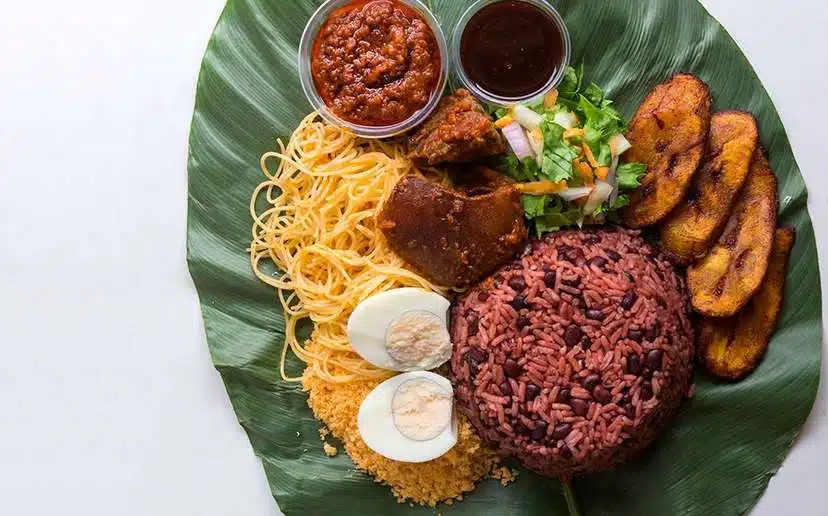
Waakye (/ˈwɑːtʃeɪ/ WAH-chay) is a beloved and popular Ghanaian dish that consists of cooked rice and beans. Although it is commonly enjoyed for breakfast or lunch, some people also savor it for supper. What sets waakye apart is its unique flavor and reddish appearance, achieved by cooking red dried sorghum leaf sheaths or stalks and limestone together with the rice and beans. Before consumption, the sorghum leaves are carefully removed from the dish. The term “waakye” originates from the Nigerian Hausa language, where it simply means “beans.” It is a shortened form of the full name “shinkafa da wake,” which translates to “rice and beans.” In Ghana, waakye is often sold by roadside vendors, and it is commonly served wrapped in a banana leaf, adding a touch of natural fragrance to the dish. It is typically accompanied by a variety of flavorful side dishes that enhance the overall dining experience. These accompaniments include Wele stew (a delicious sauce made with dried cow skin), boiled chicken eggs, garri (ground cassava), shito (a spicy black pepper sauce), vegetable salad made with cabbage, onions, and tomatoes, spaghetti (known as talia in Ghana), or fried plantain. The combination of these side dishes with waakye creates a delightful and satisfying meal for those who indulge in it. History Historically, waakye is believed to have originated from the Hausa people and their culinary traditions. It is speculated that this dish may have influenced rice and beans recipes found in the Caribbean and South America, owing to the transatlantic slave trade and the dispersion of African culinary practices. Preparation Preparing waakye involves a specific cooking method to achieve its distinctive taste and appearance. The process begins by boiling the beans together with dried millet stalk leaves. This technique softens the beans and infuses them with a reddish hue. Once the beans reach the desired consistency, rice is added to the pot, and both ingredients are cooked together. The mixture is simmered over a fire or stove until the rice is tender, absorbing the flavors of the beans, sorghum leaves, and limestone. The resulting waakye is a harmonious blend of textures and tastes, making it a favorite among Ghanaians. Waakye holds a special place in Ghanaian cuisine, appreciated for its delicious flavor, nutritional value, and cultural significance. It is not only a satisfying meal but also a symbol of Ghana’s rich culinary heritage. Whether enjoyed by locals or savored by visitors, waakye continues to be cherished and celebrated as an iconic dish that represents the diverse and vibrant flavors of Ghana. READ NEXT ON: Kete Dance